 Ember
EmberThe Ember Codex · ASRS
The ASRS v1.1, Explained: How It Is Scored and What the Score Cannot Tell You
The gold-standard adult ADHD screener is 18 questions long — and only six of them are scored. Here is what Part A actually means, and why Part B has no total.
Ah. The Adult ADHD Self-Report Scale (ASRS v1.1). Your old pal, your old self-diagnostic friend.
If you suspect that you have ADHD, ASRS v1.1 is the gold standard of early diagnostics. So, before searching for a mental health professional or the ADHD life coach in your community, ASRS could be the preemptive tool you use to reflect on your challenge.
And, don’t worry — it is only 18 questions, a five-choice checklist.
If you are an ADHD coach, ASRS could be your initial diagnostic tool. It is widely used, mainly to scale how much ADHD is affecting your client’s life.
It does not provide a definitive diagnosis or assess functional impairment. But it will suggest a high likelihood of adult ADHD if you check four or more of the shaded areas in its Part A (more on the parts below).
What the ASRS v1.1 actually is
The ASRS v1.1 is an 18-item self-report symptom checklist. It has two parts:
- Part A: six screener questions.
- Part B: twelve probing traits, to be used during interviews.
The eighteen items map onto the eighteen DSM-IV-TR symptom criteria for ADHD. You rate how often each one has applied to you over the past six months, on a five-point frequency scale.
The six questions in Part A were not chosen by clinical judgment. They were selected by statistical assessment — meaning the majority of people who check them also exhibit a real ADHD diagnosis (Kessler et al., 2005, Psychological Medicine 35(2):245–256).
The authors were careful about what that does and does not mean. In their own words, clinical calibration in larger samples might eventually show that a weighted version of the full 18-question ASRS outperforms the six-question screener — but until that time, they wrote, the unweighted screener should be preferred to the full ASRS, both in community surveys and in clinical outreach and case-finding initiatives.
That is why Part B has no score. It is designed to stimulate dialogue between you and your patients.
The ASRS v1.1 in brief
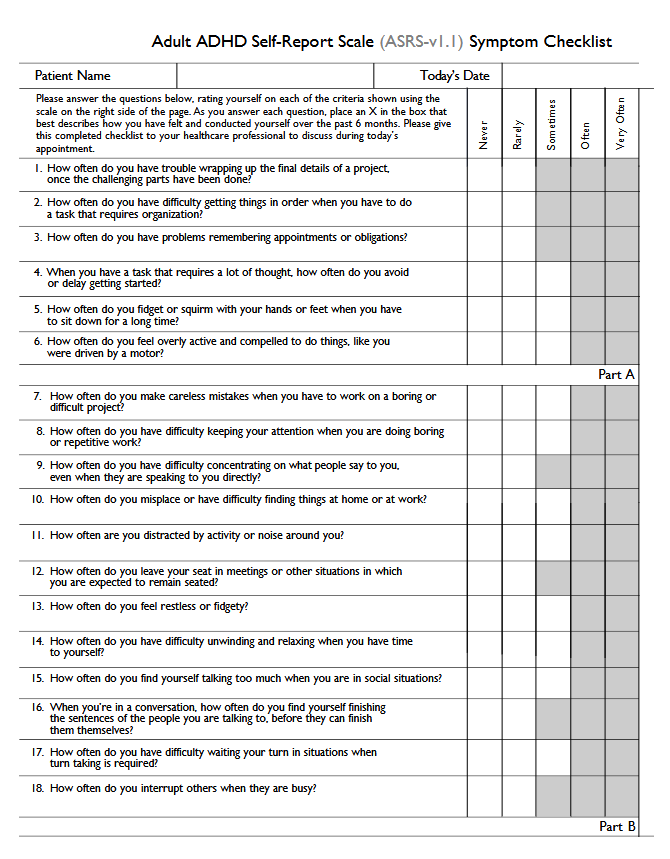
Or, take the test in Ember, complete with a PDF report as results.
How ASRS Part A is scored: four boxes of grey
Count how many of your six Part A answers land in a shaded box; four or more means you might have ADHD.
From the official version: if four or more marks appear in the darkly shaded boxes within Part A, then the patient has symptoms highly consistent with ADHD in adults and further investigation is warranted.
Note what that sentence does not say. It does not say ADHD. It says further investigation is warranted.
Why the thresholds differ: for some of the questions, answering sometimes already shows ADHD tendency, while others require often as an answer. This is because, relatively, the inattention-and-organisation items come rarer than the hyperactivity items.
Occasionally losing the thread of an appointment is already unusual enough to be signal. Occasionally fidgeting is just being a person in a chair.
How ASRS Part B is scored
It isn’t. The six questions in Part A have been found to be the most predictive of the disorder, and the best for use as a screening instrument.
Part B exists to give a clinician something to ask about. The instructions call the twelve items “additional cues” and “further probes.” That is the whole job.
This matters because the internet has invented several Part B scoring rules that do not exist. Among the pages I audited I found a Part B threshold of “27 or above,” a claim that a high Part B total is “diagnostically informative,” and a circulating rule scoring Part B out of 12 with “6 or more” as severe. None of these appear in any official source.
Google is propagating the confusion rather than resolving it. On 11 August 2026, from the same US location on the same day, Google’s AI Overview gave three different answers about Part B depending on which phrasing you searched:
- For asrs score and asrs scoring: “Range: 0 to 48… Threshold (27+): Scores from 27 to 48 point toward clinically significant impairment.”
- For asrs v1.1: “Part B Utility: Does not use a total score.”
- For asrs v1.1 scoring interpretation: “Part B is not scored with a strict cutoff” — sourced, in Google’s own citation list, to a Reddit thread and two YouTube videos.
One rule: Part B is not scored. The people who built the instrument declined to score two-thirds of it, and said so in writing.
You can take the ASRS v1.1 in Ember right now — no account, 18 questions, and a PDF of your result at the end.
First published on the Ember newsletter — subscribe there to get these as they land.