 Ember
EmberThe Ember Codex · Reading
ADHD Coaching (2025): A Review for ADHD Coaches and Mental Health Practitioners
Prevatt and Levrini's procedural guide to running an ADHD coaching engagement — what it specifies well, who it is really written for, and where the evidence runs thin.
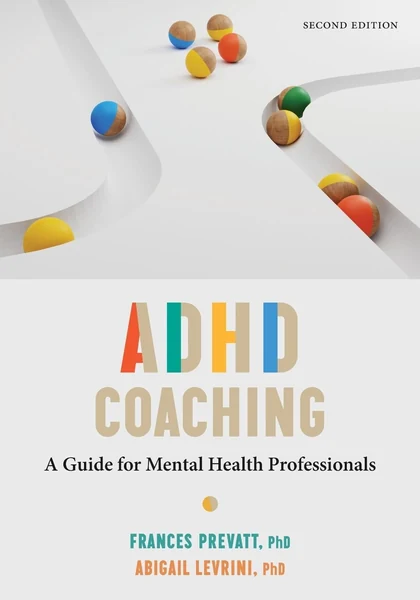
Frances Prevatt, PhD, and Abigail L. Levrini, PhD; American Psychological Association, 2025; 285 pages.
Frances Prevatt and Abigail Levrini wrote ADHD Coaching: A Guide for Mental Health Professionals for clinicians who want to add coaching to their work with ADHD clients. It is a procedural book. The authors explain what to assess, how to decide whether coaching fits, how to organize weekly sessions, and how to reduce support as a client becomes more independent.
I found it most useful when it stayed close to the work itself: selecting goals, reviewing an incomplete objective, documenting a session, or deciding when a client needs treatment alongside coaching. The forms and extended cases make the authors’ method easy to inspect. Its limitations come from the small research base for ADHD coaching and from its focus on practitioners with clinical training.
What the book covers
The first half explains the authors’ view of ADHD coaching and then follows an engagement from intake to termination. Chapters 4 and 5 divide the work into beginning, middle, and final sessions. Chapter 6 collects practical tools. Chapter 7 discusses setting up a coaching practice, including documentation, business arrangements, and professional responsibilities.
The second half contains five extended cases: a young professional, a middle-aged adult, a college student dealing with academic and lifestyle problems, an adult with coexisting mood difficulties, and an adolescent. Each case includes background information, goals, session excerpts, obstacles, and the coach’s response over time.
The book draws heavily on cognitive-behavioral theory. Its coaching model is present-focused and action-oriented, but it also asks the practitioner to understand symptoms, emotional difficulties, strengths, and the client’s wider circumstances. Coaching is presented as a structured professional relationship rather than a series of productivity suggestions.
How the coaching process works
Prevatt and Levrini organize the work into seven recurring activities:
- Check whether coaching fits the client’s goals and whether a clinical concern requires treatment or coordinated care.
- Gather information about ADHD symptoms, executive difficulties, strengths, distress, and the areas the client wants to improve.
- Select a small number of long-term goals that the client considers important.
- Convert those goals into weekly actions that can be scheduled and reviewed.
- Anticipate obstacles such as forgetting, distraction, perfectionism, task aversion, or inaccurate time estimates.
- Review what happened, including partial progress and incomplete objectives.
- Reduce reminders and accountability as the client learns to plan and review without the coach.
The review of incomplete objectives is a useful part of the method. Suppose a client planned to work on a report for 30 minutes on Tuesday evening and never began. The coach asks whether the task was still too large, whether Tuesday was realistic, whether the first action was clear, and whether the report carried an emotional burden. The answer may lead to a smaller first step, a different time, more preparation, or a decision that another goal has greater priority.
This approach keeps the weekly plan open to revision. An unfinished task provides information about the plan and the client’s circumstances. The practitioner can respond without assuming that the client lacked effort or commitment.
The forms and cases
The book includes intake materials, a coaching topics survey, a goals-and-objectives form, a progress-note template, and an evaluation form. APA provides downloadable copies.
I found the goals-and-objectives material particularly practical. A weekly review can cover motivation, fit, ease, enjoyment, quality, and barriers instead of recording completion alone. Those details help the practitioner see whether an objective was poorly timed, too broad, weakly cued, emotionally difficult, or unimportant to the client.
The cases add the judgment that a form cannot capture. They show coaches narrowing crowded agendas, adjusting how directive they are, involving parents, responding to mood symptoms, and deciding when another professional should be involved.
The session excerpts are cleaner than ordinary conversation and should be read as teaching examples. They would work well in training or supervision: pause before the coach responds, decide what you would do, and then compare your reasoning with the authors’.
Clinical scope and research
The intended reader is a mental health professional. The book assumes familiarity with screening, mood symptoms, assessment, treatment, and coordinated care. A coach without clinical credentials can use its session structure and planning methods, but the clinical material does not extend that coach’s legal or professional scope. Diagnosis, psychological testing, medication advice, and treatment of mood disorders require the appropriate qualifications.
Clinicians may face a different gap. Clinical training alone may not prepare someone for the collaborative, client-directed style described here. Coaching skills still require practice, observation, and feedback.
The research base also needs to be read precisely. Parts of the model resemble cognitive-behavioral treatment, psychoeducation, problem-solving, and organizational-skills interventions with stronger supporting evidence. Research on ADHD coaching as its own intervention remains limited. A 2026 JAMA Network Open investigation described a literature made up largely of case studies, small pre–post evaluations, and one randomized study involving college students. The Australian evidence-based ADHD guideline similarly rates the evidence for coaching as weak and notes the small amount of available research.
The available studies leave important questions unanswered, including which clients benefit, how much coaching is appropriate, and how outcomes vary by format or practitioner background. I would treat the book as a detailed account of a practice model, not as evidence that every part of the model has been validated.
Chapter 7 should also be supplemented with current local information. Billing, privacy, telepractice, and legal requirements vary by profession and jurisdiction and may change after publication.
Public reviews and nearby alternatives
Professional endorsements of the 2025 book praise its practical instruction, research discussion, forms, and detailed cases. Those comments match the contents. Independent reviews are scarce. Retail listings mostly repeat APA’s description, while the small number of Goodreads ratings and written reviews cannot support a broad conclusion about how practitioners use the book over time.
Several related books serve different purposes. Safren and colleagues’ Mastering Your Adult ADHD presents a more tightly specified adult CBT program. Solanto provides a session-by-session group treatment. Dawson and Guare focus on executive-skills work with school-age clients. Ramsay and Rostain’s The Adult ADHD Tool Kit is written in a form that works well as guided client reading. All four sit alongside this one in our 24-book reading guide for ADHD coaches, where this book is entry one.
Prevatt and Levrini cover a wider span of the coaching engagement. Their book is aimed at the practitioner who wants to see how assessment, weekly planning, review, documentation, referral, and termination fit together in clinical work.
Overall assessment
The 2025 edition is a practical guide to building ADHD coaching into mental health practice. Its main contribution is specificity: the reader can see the sequence of sessions, the paperwork, the weekly review process, and the decisions made in several client cases.
It does not replace training, supervision, crisis procedures, or local professional guidance. Within those limits, it gives its intended reader a clear example of how an ADHD coaching practice can be organized and carried out.
Sources
- American Psychological Association: ADHD Coaching, 2025 edition
- APA sample pages
- Sibley et al. (2026): Demographics, Services, and Practices in Attention-Deficit/Hyperactivity Disorder Coaching in the US
- Australian ADHD Clinical Practice Guideline: ADHD Coaching
- Ahmann and Saviet (2024): Development of a manualized coaching intervention for adult ADHD
Ember Console is the write-up half of the work this book describes — your letterhead, your boxes, and the session report drafted inside the AI you already use. Closed beta, four free reports a month.