 Ember
EmberThe Ember Codex · Reading
24 Books Every ADHD Coach and Mental Health Professional Should Know
A professional reading guide to ADHD coaching, CBT, executive-function work, mindfulness, and specialist clinical practice
Published by Ember, an ADHD coaching app by ANYE
Published: September 1, 2026 · Research current through: September 1, 2026
Editorial note: The rankings, recommendations, “Best for” labels, and Ember verdicts in this article are Ember’s editorial judgments. They reflect our reading of the research, professional reviews, practitioner reception, and the books themselves; they are not consensus rankings or endorsements from the authors, publishers, or professional organizations mentioned.
Most “best ADHD books” lists are written for people with ADHD. This one is for the people who work with them.
Search results are crowded with self-help books, memoirs, workbooks, and introductions for newly diagnosed adults. Many deserve the attention. They are much less useful when the question is what a coach, therapist, psychologist, counselor, psychiatrist, or educational therapist should read to get better at the work.
We went looking for a professional ADHD-coaching canon and found several overlapping traditions instead. Some books teach coaching directly. Others come from CBT, executive-function intervention, mindfulness, psychiatry, educational therapy, or developmental psychology. CHADD’s own coaching bibliography crosses those boundaries, including dedicated coaching books alongside Mary Solanto’s CBT manual.
For this review, we read professional bibliographies, publisher material, journal and practitioner reviews, reader reviews, training recommendations, and recent 2025–2026 releases. We gave more weight to books with tested protocols, substantial independent professional use, or unusually clear practical value. Newer practitioner books are included too, but we say when the outside evidence is still thin.
The useful question, then, is what a practitioner can learn from each title, how directly that lesson transfers into practice, and where the book’s limits are.
How to read the positioning boxes: The summaries below are Ember’s reconstruction of how each author and publisher positions the book, using April Dunford’s logic: what the reader would otherwise use, what this book has that those alternatives do not, the value that difference creates, who cares most, and the market frame that makes the book easiest to understand. They are not direct quotations from the authors unless explicitly marked as such.
About the boring book facts: Page counts can differ across hardcover, paperback, and ebook editions. Where that happens, we identify the format tied to the ISBN shown.
About the covers: Each cover is shown at thumbnail size to identify the edition under review. The covers remain the property of their publishers and authors; showing them here is not a sign that any publisher or author endorses this review.
Part I: Books That Actually Teach ADHD Coaching
1. ADHD Coaching: A Guide for Mental Health Professionals, Second Edition — Frances Prevatt and Abigail Levrini
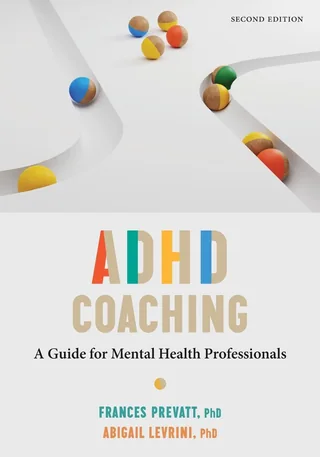
Book facts: American Psychological Association · August 2025 · 2nd edition · 285 pages · ISBN-13 9781433843723
Writer background: Prevatt is a psychologist and ADHD researcher; Levrini is a clinical psychologist and ADHD coach. Their work helped turn ADHD coaching into an empirically studied professional intervention rather than a loose collection of productivity advice.
Positioning: For mental-health professionals who need to run ADHD coaching, this is a practitioner textbook. The real alternative is piecing together self-help advice, generic CBT, and coaching lore; its edge is an end-to-end, research-linked process with forms, cases, and guidance for each stage of coaching.
A practical textbook for running professional ADHD coaching
If you want one book that explains how to conduct ADHD coaching from beginning to end, start here.
We have since given this one a full read: ADHD Coaching by Prevatt and Levrini, on its method, its forms and cases, and where its evidence base runs thin.
Published by the American Psychological Association in August 2025, the second edition walks practitioners through intake, assessment, goal formulation, early sessions, middle sessions, termination, coaching tools, documentation, practice development, and multiple detailed case studies covering adolescents, college students, working adults, and clients with comorbid mood problems.
What distinguishes Prevatt and Levrini from much of the coaching literature is their insistence on connecting ADHD coaching to empirical research. They define coaching as a skill-based intervention targeting planning, time management, goal setting, organization, problem solving, and the functional impairments surrounding ADHD.
The original edition was already described by psychologist James Luiselli as one of the strongest practical guides available to mental-health professionals working with ADHD, particularly because of its cases, forms, progress tracking, and grounding in research.
The 2025 revision matters because the ADHD world has moved considerably since the first edition appeared in 2015. There is more coaching research, greater attention to adults, more awareness of emotional and interpersonal impairment, and growing tension between deficit-oriented and neuroaffirming models.
This is the best starting point for someone asking, “How is professional ADHD coaching actually done?” It is structured enough to teach from without becoming merely a collection of productivity tips.
Its limitation is almost the reverse of many popular ADHD books: this is a practitioner manual, not a manifesto about ADHD identity or neurodiversity. Coaches wanting a more explicitly strengths-, identity-, or flourishing-oriented framework should pair it with the next book.
Best for: ADHD coaches, psychologists, counselors, therapists and graduate trainees.
Ember’s verdict: The current foundational ADHD-coaching textbook.
2. Flourishing with Adult ADHD — Elizabeth Ahmann and Micah Saviet
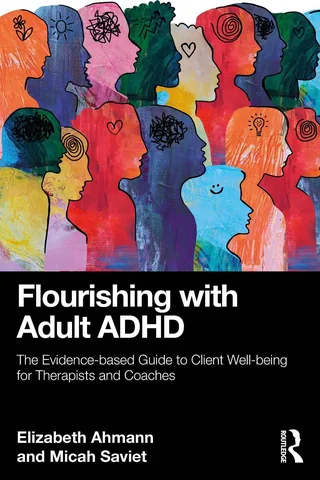
Book facts: Routledge · April 2026 · 1st edition · 402 pages (paperback) · ISBN-13 9781041059776
Writer background: Ahmann is an ADHD and health-and-wellness coach, coach educator, and researcher; Saviet combines ADHD coaching with licensed clinical social work. Both work at the intersection of coaching practice and research.
Positioning: For adult-ADHD coaches and therapists who find impairment-reduction manuals too narrow, this is an evidence-based, neuroaffirming wellbeing guide. Compared with skills-first or deficit-first books, it combines coaching science with positive psychology, self-determination, identity, mindfulness, and strengths so success means more than getting organized—it means building a life the client wants.
A 2026 attempt to broaden what ADHD coaching is for
If Prevatt and Levrini represent the mature version of traditional evidence-informed ADHD coaching, Flourishing with Adult ADHD may represent where the field is going next.
Ahmann and Saviet are both ADHD and health-and-wellness coaches; Saviet is also a licensed clinical social worker. Their 2026 Routledge book is explicitly written for therapists and coaches and integrates ADHD research with coaching science, positive psychology, self-determination theory, mindfulness, strengths, identity, resilience, self-compassion and wellbeing.
Older ADHD intervention literature is usually organized around impairment: planning, follow-through, organization, and symptom management. Ahmann and Saviet keep those concerns in view while adding wellbeing, identity, autonomy, strengths, and self-determination. The practical effect is a wider definition of success than simply getting the client to execute.
The book covers the coaching alliance, sociocultural considerations, strengths, health, executive functioning, mindfulness, ADHD identity, hope, self-determination, motivation, growth mindset, and breaking goals into manageable steps.
This is not fluffy strengths-based coaching presented in opposition to science. One reason the book is notable is precisely its attempt to integrate neuroaffirming practice with research.
Early professional endorsements from Ari Tuckman, Russell Ramsay and Jodi Sleeper-Triplett specifically praise the combination of research, usable interventions and a strengths/wellbeing orientation.
There is also a timely research connection: Ahmann and colleagues published a 2026 prospective study of a manualized 12-session adult ADHD coaching intervention reporting improvements across goal attainment, ADHD symptoms, executive functioning and functional impairment, while appropriately noting limitations around design and sample generalizability.
This is the professional ADHD book we would watch most closely over the next several years. It addresses a genuine weakness in older intervention literature: helping clients become more organized is not the same thing as helping them construct a satisfying life.
Because the book only appeared in April 2026, substantial independent review literature has not yet accumulated. Its reputation currently rests more heavily on its research foundation, content, and expert reception than long-term field use.
Best for: adult ADHD coaches and therapists wanting an evidence-informed but explicitly neuroaffirming framework.
Ember’s verdict: The strongest candidate for the next-generation ADHD coaching canon.
3. Empowering Youth with ADHD — Jodi Sleeper-Triplett
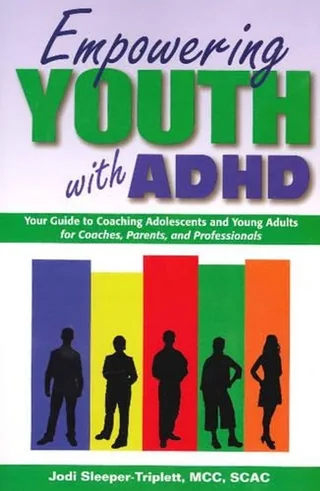
Book facts: Specialty Press · 2010 · 225 pages · ISBN-13 9781886941960
Writer background: Sleeper-Triplett is one of the early specialists who helped establish ADHD coaching for adolescents and young adults, and has spent much of her career training coaches to work with youth.
Positioning: For coaches working with teenagers and emerging adults, this is a youth-specific ADHD coaching manual. Instead of adapting adult coaching or generic parenting and tutoring advice, it deals directly with parent involvement, autonomy, motivation, agreements, and the mechanics of coaching a client who is still developing independence.
An early youth-coaching manual that still holds up
Jodi Sleeper-Triplett helped define ADHD coaching for adolescents and young adults before youth ADHD coaching was a mature specialty.
Her book explains what coaching is, how to establish agreements, how to involve parents without undermining autonomy, how to motivate younger clients, and how coaching differs from other professional relationships.
CHADD includes it in its core ADHD-coaching reading list.
A professional review in ADDitude argued that the book becomes especially strong when Sleeper-Triplett moves from general ADHD discussion into the actual mechanics of interviewing families, identifying coaching barriers, motivating young people and running the coaching process.
A later review in The Educational Therapist called Sleeper-Triplett’s work the more engaging introduction when compared with Sarah Wright’s profession-oriented ADHD Coaching Matters.
Reader feedback is small in volume but useful. One thoughtful criticism questioned the delayed reward structures used in some examples, arguing that they may underestimate the importance of immediacy and intrinsic motivation for ADHD clients.
That criticism also shows where the book now needs updating. The framework remains important. Some motivational techniques reflect the period in which the book was written and deserve to be read alongside newer work on autonomy, self-determination, motivational interviewing and ADHD motivation.
Best for: coaches working with teenagers, transition-age youth and young adults.
Ember’s verdict: Historically canonical and still practically relevant, but ready for a modern theoretical update.
4. Coaching College Students with AD/HD: Issues and Answers — Patricia Quinn, Nancy Ratey and Theresa Maitland
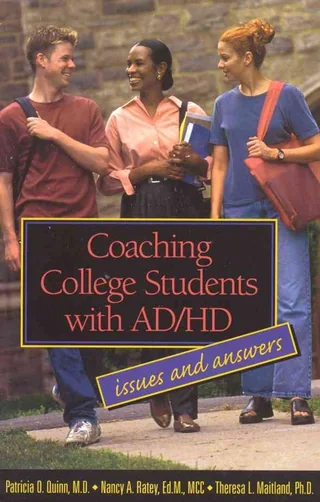
Book facts: Advantage Books · 2000 · 218 pages · ISBN-13 9780966036671
Writer background: Quinn is a developmental pediatrician and longtime ADHD author; Ratey and Maitland were early practitioners in ADHD coaching and college-student support. Together they wrote during the period when ADHD coaching was becoming a distinct professional practice.
Positioning: For people helping college students whose old parental scaffolding has disappeared, this is an issue-by-issue coaching manual. The alternative is generic academic advising or adult coaching; its distinctive value is concrete external structure for calendars, long assignments, routines, accountability, stress, and the transition to independent living.
An early college-coaching manual with surprisingly durable mechanics
This is one of the most interesting books in the professional ADHD-coaching canon precisely because it is now easy to overlook.
Published in 2000, Coaching College Students with AD/HD organizes common coaching problems in an issue-and-answer format: accountability, calendars, routines, problem solving, long assignments, planning, external structures, self-talk, medication, stress and the transition away from parental scaffolding.
One early practitioner review called it useful for all ADHD coaches, not merely college specialists, because it provides concrete check-ins, step-by-step coaching recommendations and session mechanics instead of stopping at theory.
Its age is the main limitation. Terminology, technology, disability services, attitudes toward ADHD, college environments, and the evidence base have all changed since 2000.
Yet the mechanics of externalizing executive function—making deadlines visible, breaking projects down, constructing accountability and creating routines—remain strikingly recognizable.
Do not buy this primarily for current ADHD science. Read it as an early manual of how ADHD coaching became a distinct practice.
It is also an excellent historical comparison point for the 2024 Thriving in College with ADHD manual reviewed later in this article.
Best for: ADHD-coaching historians, college coaches and practitioners interested in the origins of the field.
Ember’s verdict: Dated science; surprisingly durable coaching mechanics.
5. Coaching Students with Executive Skills Challenges, Second Edition — Peg Dawson and Richard Guare

Book facts: Guilford Press · May 2023 · 2nd edition · 226 pages · paperback ISBN-13 9781462552191
Writer background: Dawson and Guare are psychologists best known for translating executive-function research into practical interventions for children and adolescents.
Positioning: For K–12 practitioners who need more than generic study-skills advice, this is an executive-skills coaching manual. Compared with broad ADHD books, it offers an individualized coaching model, motivational interviewing, cognitive rehearsal, goal and action planning, progress monitoring, and reusable tools that make executive-function support operational.
A detailed school-age executive-function coaching manual
This is an executive-function coaching book rather than an ADHD-only book. The overlap is large enough, especially for school-age clients, that it belongs in a youth ADHD professional library.
The significantly revised 2023 edition added material on younger children, motivational interviewing, cognitive rehearsal, coach self-assessment, goal setting, action planning, progress monitoring and updated digital tools. Guilford describes the revision as containing 55% new material.
Professional reviews consistently praise its practicality. Doody’s highlighted its combination of voluntary participation, evidence-informed tools and progress monitoring; school and executive-function professionals praise the templates and step-by-step framework.
Margaret Sibley has particularly highlighted its increased emphasis on collaboration and shared decision-making—an important evolution away from simply imposing organizational systems on a student.
If your ADHD coaching work involves school-age clients, this may give you more immediately usable intervention architecture than many books explicitly carrying “ADHD coaching” in the title.
The tradeoff is conceptual breadth: because the intervention is organized around executive skills rather than ADHD as a whole person, coaches still need other resources for identity, emotional regulation, comorbidity and ADHD-specific psychoeducation.
Best for: school psychologists, educational therapists, ADHD coaches, executive-function coaches and educators.
Ember’s verdict: Best-in-class practical executive-function coaching manual for younger clients.
6. ADHD Coaching Matters: The Definitive Guide — Sarah D. Wright
Book facts: ACO Books · July 2014 · 1st edition · 184 pages · ISBN-13 9780692205266
Writer background: Wright is a longtime ADHD coach, author, and chronicler of the field’s development, with particular attention to how ADHD coaching became organized as a profession.
Positioning: For someone trying to understand the profession of ADHD coaching, this is a field guide rather than a session manual. Its alternatives are technique books and generic coach training; what it uniquely explains is the history, credentials, certification systems, organizations, ethics, liability, and professional infrastructure around the work.
Read this to understand the profession, not to learn a session protocol
Wright’s book is often misclassified as a technique manual.
Sarah Wright is a major figure in ADHD coaching, and CHADD includes ADHD Coaching Matters among its suggested coaching books.
But its distinctive contribution is not a step-by-step intervention protocol.
It maps the profession itself: what ADHD coaching is and is not, how it developed, credentials, certification systems, training programs, professional organizations, liability and the infrastructure surrounding professional practice.
A 2021 review written for educational therapists makes the contrast explicit. Wright’s book is useful for navigating the history, training ecosystem and bewildering collection of professional acronyms, while Sleeper-Triplett gives readers a more direct feel for the work of coaching young people.
Essential if you want to understand how ADHD coaching became a profession. Secondary if your immediate question is “What should I do with my client next Tuesday?”
It is also historically valuable because professional organizations such as the ADHD Coaches Organization draw on Wright’s account when describing the development of the field.
Best for: prospective ADHD coaches, coach educators, researchers and professionals evaluating the coaching ecosystem.
Ember’s verdict: The profession-and-history book, not the technique book.
7. Neurodiversity Coaching — Nancy Doyle and Almuth McDowall
Book facts: Routledge · 1st edition · copyright 2024 · 298 pages (paperback) · ISBN-13 9781032436524
Writer background: Doyle is an occupational and coaching psychologist whose work centers on disability and neuroinclusion; McDowall is an organizational psychologist and researcher on neurodiversity, wellbeing, and coaching at work.
Positioning: For established coaches, managers, and organizational practitioners moving into neurodiversity, this is a coaching-psychology bridge. Instead of either generic coaching models or ADHD-only symptom manuals, it combines workplace context, research, contracting, supervision, safeguards, and neurodivergence-specific practice across ADHD, autism, dyslexia, dyspraxia, and related differences.
A bridge from mainstream coaching psychology into neurodiversity
This 2024 Routledge book covers more than ADHD: autism, dyslexia, dyspraxia and other forms of neurodivergence sit alongside it.
That broader scope is a feature rather than a defect for professionals working in workplaces, leadership, career development and organizations.
Doyle and McDowall are occupational psychologists as well as practitioners. Their approach includes coaching psychology, contracting, supervision, workplace context, case studies, reflective questions and careful attention to the boundary between coaching and therapy.
A particularly useful 2026 independent professional review came from chartered coaching psychologist Petra Walker. She praised the authors for combining evidence-based models with practical case studies and for taking the coaching/therapy boundary seriously—something she contrasted with the proliferation of smaller ADHD/autism coaching publications.
Walker also reported that the book changed how she thought about contracting, supervision and working with neurodivergent clients who disclose diagnoses during an existing coaching engagement.
That kind of report from an independent practitioner tells us more about day-to-day usefulness than a cover endorsement.
For an experienced general coach entering neurodiversity work, this may be a better first purchase than an ADHD-only manual. It assumes professional coaching practice and asks how that practice must change when neurotypical assumptions no longer hold.
For a practitioner seeking detailed ADHD-specific symptom management, it is too broad to stand alone.
Best for: workplace coaches, coaching psychologists, executive coaches, career coaches and organizational practitioners.
Ember’s verdict: Best professional bridge from mainstream coaching into neurodiversity.
8. ADHD Coaching: Inside the Process — Strategy Meets Practice — Nea Clark
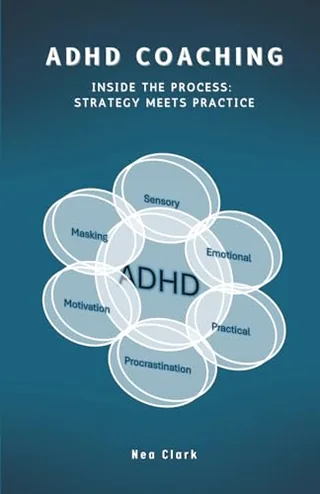
Book facts: Independently published · May 12, 2025 · ISBN-13 9798282629576
Writer background: Clark is a psychotherapist, ADHD coach, supervisor, and practitioner trainer whose work combines clinical experience with day-to-day ADHD coaching.
Positioning: For experienced practitioners who want contemporary, immediately usable ADHD-coaching material, this is a session-level practitioner toolkit. Compared with academic manuals and generic coaching books, it foregrounds coaching questions and frameworks for emotional regulation, masking, motivation, sensory issues, and time management; the tradeoff is that independent validation remains limited.
Interesting emerging practitioner material, but not yet independently validated
Nea Clark is a UK psychotherapist and ADHD coach whose recent books sit outside the traditional academic-publishing ecosystem.
Inside the Process focuses explicitly on ADHD coaching and offers frameworks, coaching questions and tools around emotional regulation, motivation, masking, time management and other common coaching issues. Clark describes her approach as informed by psychotherapy, ADHD coaching, professional experience and specialist ADHD work.
This kind of practitioner literature belongs in the review because useful professional knowledge does not come only from APA, Oxford, and Guilford. The difficulty is judging provenance.
As of our September 2026 search, the author’s own sales page still stated that there were no customer reviews, and we found little substantial independent critical coverage.
The lack of independent coverage is not evidence against the book; it simply means we do not yet know how the broader professional community evaluates it.
Promising practitioner literature worth examining, particularly for session questions and contemporary neurodivergent themes. It should not yet be placed on the same evidentiary tier as established, researched manuals from APA or Guilford.
Best for: experienced practitioners curious about newer ADHD-coaching methodologies.
Ember’s verdict: Interesting and current; independent validation still thin.
9. Travel into the ADHD Mind: Strategies for Working with ADHD Clients — Nea Clark
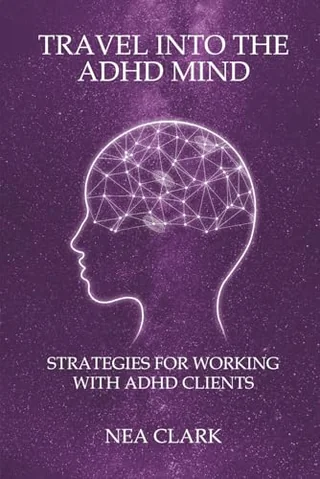
Book facts: Nea Clark · September 4, 2024 · 359 pages · ISBN-13 9781917438667
Writer background: Clark is a psychotherapist and ADHD coach who trains other coaches and mental-health practitioners to work more confidently with ADHD clients.
Positioning: For therapists, counselors, and coaches who need an applied introduction to ADHD work, this sits between a therapy guide and a coaching manual. Its alternative is choosing either a generic ADHD introduction or a single-modality manual; its difference is the integrated treatment lens spanning attention, procrastination, masking, sensory processing, and energy management.
A therapist-coach hybrid rather than a pure coaching manual
Clark’s earlier Travel into the ADHD Mind is aimed at therapists, counselors and coaches wanting a framework for working with ADHD clients.
Topics include attention, procrastination, masking, sensory processing and energy management.
Its hybrid audience is important. The modern ADHD helping ecosystem has increasingly porous boundaries between therapy, coaching, psychoeducation and executive-function support. Clark explicitly writes into that overlap.
The breadth is useful, but it also makes scope more important. Practitioners need to stay clear about competence and about which interventions belong within coaching versus psychotherapy.
Potentially useful as a contemporary practice-oriented companion, especially for therapists newly encountering ADHD. But independent review coverage remains sparse, so we currently classify it as emerging practitioner literature, not an established professional standard.
Ember’s verdict: Worth knowing about; too early for canonical status.
10. The Guide to ADHD Coaching — edited by Alan R. Graham
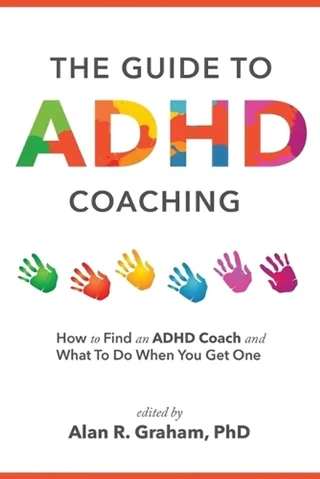
Book facts: Motivational Press LLC · November 7, 2018 · 256 pages · ISBN-13 9781628655704
Writer background: Graham is a psychologist, therapist, coach, and coach educator with decades of ADHD work and experience training professional coaches. He assembled multiple contributors rather than presenting a single proprietary method.
Positioning: For readers who need a map of ADHD coaching before choosing or practicing it, this is a broad field guide. Instead of a technique-only manual—or choosing a coach from vague credentials—it covers what coaching is, research, accreditation, ethics, coach selection, and different client populations through multiple professional voices.
Broad map of the field; oddly under-read
Alan Graham’s book occupies an unusual position between practitioner handbook and consumer guide.
It discusses how coaching works, how to select a coach, credentials, accreditation, ethics, research and specialty populations.
Its contributor structure gives readers multiple professional viewpoints instead of presenting ADHD coaching as one author’s proprietary method.
The public reader footprint is tiny—Goodreads currently shows only a handful of ratings—but the sole detailed review there comes from psychologist Gene Carroccia, who specifically praises the book’s breadth across accreditation, ethics, research and different client populations.
More useful as a map of ADHD coaching than as the one manual you keep open during a session.
Its obscurity is interesting. Professional importance and mass-market popularity are almost completely disconnected in this field.
Best for: practitioners entering ADHD coaching and professionals trying to understand the field’s breadth.
Ember’s verdict: Underknown, broad and useful—but not the deepest intervention manual.
Part II: Clinical Manuals ADHD Coaches Should Know
The coaching literature does not contain all of the field’s best work on planning, avoidance, procrastination, compensatory systems, or the intention–action gap. Much of that work was developed and tested inside CBT and other psychosocial treatments. Coaches should borrow from it carefully: a useful behavioral technique does not erase the boundary between coaching and psychotherapy.
11. Cognitive-Behavioral Therapy for Adult ADHD: Targeting Executive Dysfunction — Mary V. Solanto
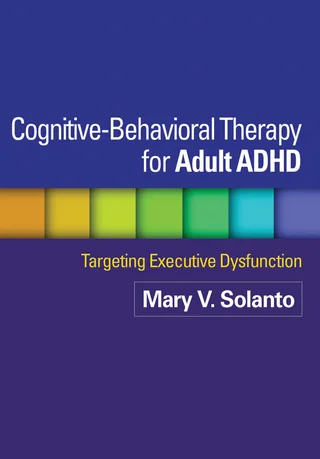
Book facts: Guilford Press · copyright 2011; paperback edition 2013 · 214 pages · paperback ISBN-13 9781462509638
Writer background: Solanto is a psychologist and ADHD researcher whose work spans cognitive and behavioral functioning, treatment, and professional training in adult and child ADHD.
Positioning: For clinicians who want executive-function treatment to become a repeatable intervention rather than a list of tips, this is a manualized CBT program. Compared with generic CBT or self-help, it provides a 12-session sequence for time management, organization, planning, and coping, with leader notes, exercises, homework, and reproducible materials.
Possibly the most transferable clinical manual for an ADHD coach
If an ADHD coach wanted to study one therapist manual without becoming a CBT specialist, this would be a strong candidate.
Solanto’s manual is built around 12 structured sessions addressing time management, organization, planning and coping. Although written primarily for group therapy, the model can be adapted for individual work and includes leader notes, exercises, homework, handouts and guidance on tailoring treatment.
The program received CHADD’s Innovative Program of the Year Award, and CHADD includes Solanto on its ADHD-coaching suggested reading list.
The practitioner reaction is unusually concrete. A psychiatry resident reviewing it described using the group-oriented techniques successfully in individual therapy and found the skills applicable to high-functioning adults struggling with time management and organization. A 2023 reviewer similarly emphasized the usefulness of the session examples for psychologists and psychiatrists.
And one practitioner who reviewed the competing Safren therapist manual explicitly said they preferred Solanto because it was more user-friendly and provided client materials more conveniently.
One of the best professional manuals for understanding what “executive-function intervention” looks like when operationalized into an actual treatment sequence.
Coaches must distinguish therapy from coaching, but many of the behavioral mechanics are extraordinarily relevant.
Ember’s verdict: Core professional shelf.
12. Mastering Your Adult ADHD: A Cognitive-Behavioral Treatment Program — Therapist Guide — Steven Safren, Susan Sprich, Carol Perlman and Michael Otto
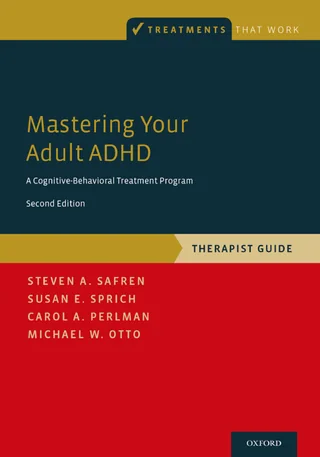
Book facts: Oxford University Press · May 2017 · 2nd edition · 184 pages · print ISBN-13 9780190235581
Writer background: Safren, Sprich, Perlman, and Otto are clinical psychologists and CBT researchers who developed and tested a structured psychological treatment for adult ADHD.
Positioning: For CBT-trained therapists treating adults whose ADHD impairment persists despite medication or ordinary coping advice, this is a session-by-session treatment program. Its advantage over generic CBT is ADHD-specific modules for planning, distractibility, adaptive thinking, procrastination, and relapse prevention, paired with a client workbook.
The classic manualized adult ADHD CBT program
The Safren program is one of the best-known evidence-supported psychological treatments for adult ADHD.
Its core modules cover organization and planning, reducing distractibility, adaptive thinking and procrastination, with relapse prevention and optional family/partner involvement. The second edition also incorporated smartphones and technology into organizational work.
Recent reader feedback from 2024 still describes the approach as useful precisely because it acknowledges residual impairment despite medication and provides practical coping strategies alongside pharmacological treatment.
There is, however, a small but useful usability criticism.
The therapist guide and separate client workbook do not align perfectly chapter-for-chapter, and at least one clinician reviewer disliked requiring clients to purchase the additional workbook—while preferring Solanto’s manual on usability grounds.
This is more explicitly CBT than coaching, particularly once adaptive cognitions enter the model.
But for coaches who collaborate with therapists—or clinicians trying to understand where coaching ends and CBT begins—it is foundational reading.
Ember’s verdict: Canonical adult-ADHD CBT; more structured and clinical than most coaches need, but important to understand.
13. Cognitive Behavioral Therapy for Adult ADHD: An Integrative Psychosocial and Medical Approach — J. Russell Ramsay and Anthony Rostain
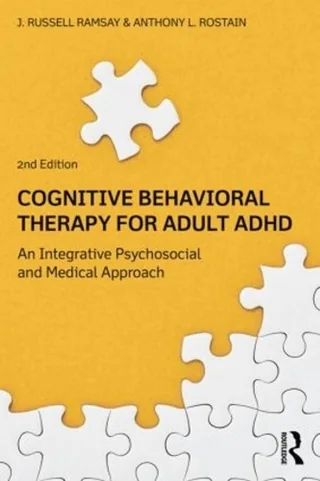
Book facts: Routledge · 2015 · 2nd edition · 252 pages · ISBN-13 9780415815918
Writer background: Ramsay is a clinical psychologist who co-founded Penn’s adult ADHD treatment program; Rostain is a psychiatrist and longtime adult-ADHD clinician and researcher. Their collaboration joined psychotherapy and medical treatment rather than treating them as separate camps.
Positioning: For clinicians asking why clients know useful strategies but still fail to use them, this is an integrative CBT model. Compared with skills-only manuals or medication-only approaches, it links coping strategies to avoidance, thinking patterns, emotional barriers, and pharmacotherapy, giving practitioners a deeper model of the intention-to-action failure.
A strong explanation for why good ADHD strategies fail in real life
Ramsay and Rostain’s model is particularly valuable because it does not treat ADHD intervention as merely giving clients better planners.
Their CBT framework integrates coping strategies with the thinking patterns and avoidance behaviors that prevent clients from actually deploying those strategies.
The second edition combines psychosocial and medical treatment and remains explicitly designed for clinicians treating adults with ADHD.
For coaches, the important issue is whether the work remains skill building and behavior change or moves into treatment of entrenched cognitions and clinical symptoms.
A client can know perfectly well that breaking a project into small pieces is sensible while repeatedly avoiding the project anyway.
The intervention question then becomes:
What is happening between intention and action?
That problem has become one of Ramsay’s defining contributions to adult ADHD treatment.
Less “plug-and-play” than Solanto if what you want is a session curriculum. More valuable if you want a deep conceptual model of the psychological barriers surrounding execution.
Ember’s verdict: Essential theory for sophisticated ADHD behavior-change work.
14. Integrative Treatment for Adult ADHD — Ari Tuckman
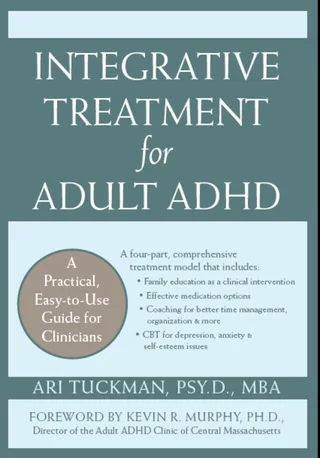
Book facts: New Harbinger Publications · 2007 · 252 pages · ISBN-13 9781572245211
Writer background: Tuckman is a clinical psychologist specializing in the diagnosis and treatment of ADHD and a longtime educator of both professionals and the public.
Positioning: For busy clinicians and coaches who need to understand where their work sits inside the whole treatment system, this is a multimodal clinical guide. Its alternative is a single-method book; its distinguishing move is to integrate education, medication, coaching, and CBT into one treatment model, clarifying what each modality can and cannot do.
One of the clearest books on how coaching fits inside multimodal ADHD care
Published in 2007, Tuckman’s book is older but conceptually important because it explicitly treats adult ADHD care as an integration of education, medication, coaching and cognitive behavioral therapy.
That makes it especially relevant for ADHD coaches.
A recurring problem in the field is treating professional modalities as competing products:
Medication versus therapy.
Therapy versus coaching.
Coaching versus psychoeducation.
Tuckman’s model instead asks what each modality is good at and how they complement one another.
Professional praise has emphasized both scientific accuracy and practical usefulness, including its value for clinicians understanding the roles of other members of an ADHD treatment team.
Some clinical details inevitably show their age, particularly given changes in ADHD research since 2007.
But the multimodal philosophy has aged extremely well.
Ember’s verdict: An important antidote to “one intervention solves ADHD” thinking.
15. Mindfulness for Adult ADHD: A Clinician’s Guide — Lidia Zylowska and John Mitchell
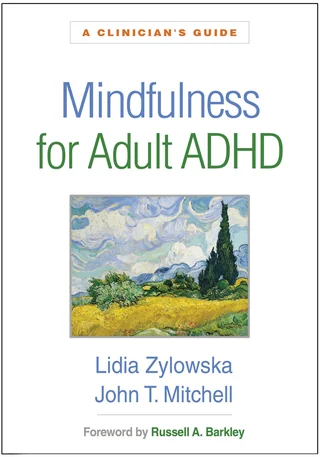
Book facts: Guilford Press · December 2020 · 207 pages · paperback ISBN-13 9781462545001
Writer background: Zylowska is a psychiatrist and pioneer of mindfulness-based treatment for adult ADHD; Mitchell is a psychologist and adult-ADHD researcher who conducted controlled research on the MAPs for ADHD program.
Positioning: For clinicians who want to use mindfulness without simply importing a standard meditation course, this is an ADHD-adapted mindfulness manual. Compared with generic mindfulness programs, MAPs uses shorter practices, ADHD psychoeducation, stepwise teaching, guided scripts, handouts, and adaptations for individual therapy to train attention and emotional self-regulation in an ADHD-compatible way.
An ADHD-specific mindfulness protocol for clinicians
Generic mindfulness advice can fail spectacularly with ADHD clients.
Zylowska and Mitchell’s contribution is adapting mindfulness specifically to ADHD rather than assuming a standard meditation program can simply be copied over.
Their eight-week Mindful Awareness Practices for ADHD program uses shorter meditation periods, ADHD psychoeducation, guided scripts, structured session summaries, downloadable exercises and adaptations for individual therapy.
Professional response has been strong. Russell Barkley described it as the most detailed practical guide for clinicians wanting to implement ADHD-adapted mindfulness, while other clinicians have praised the fact that the exercises were designed around the disorder rather than borrowed wholesale from generic mindfulness practice.
Reader reaction adds an interesting counterpoint.
StoryGraph ratings hover around 3.9, with some readers finding the program respectful and ADHD-friendly, while others complain that the text itself is slow or awkward to read as a person with ADHD.
Excellent professional protocol; less convincing as a casual self-help read.
That is not necessarily a flaw. The intended user is the practitioner delivering the intervention.
Ember’s verdict: Best dedicated professional manual for ADHD-adapted mindfulness.
16. Rethinking Adult ADHD: Helping Clients Turn Intentions Into Actions — J. Russell Ramsay
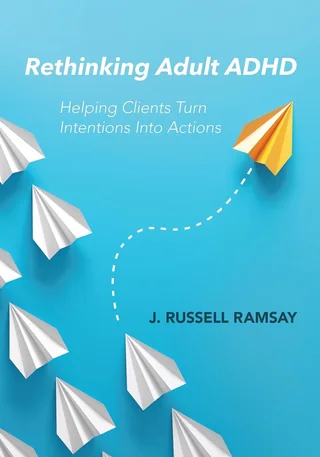
Book facts: American Psychological Association · December 2019 · 213 pages · ISBN-13 9781433831508
Writer background: Ramsay is a clinical psychologist and co-founder of an adult ADHD specialty program whose work has focused heavily on CBT and the psychology of follow-through.
Positioning: For practitioners whose clients already know the planner, calendar, or coping strategy they should use, this is a conceptual guide to the intention–action gap. Instead of offering another productivity system, it explains the cognitive and behavioral mechanisms that block implementation, helping the practitioner intervene where execution actually breaks down.
The book for clients who already know what they should do
Ramsay starts from a problem practitioners see constantly: a client can understand a strategy, agree that it would help, and sincerely intend to use it, then still fail to act on that intention.
Then they don’t.
Ramsay focuses on the cognitive layer around this gap: self-distrust, self-mistrust, avoidance, dysfunctional beliefs and patterns developed after years of inconsistent performance.
APA describes the book as a blueprint for adapting cognitive techniques specifically to adult ADHD, with case material demonstrating how thoughts and beliefs interact with behavioral coping.
Professional reviewers have called the book an important contribution precisely because it moves beyond a simplistic “executive deficit = teach organizational skills” model and looks at the beliefs that interfere with implementation.
Coaches need to be careful here: treating entrenched dysfunctional cognitions may move squarely into psychotherapy.
But conceptually, this may be one of the most important books an ADHD coach can read.
It explains why knowing the system is not the same as using the system.
Ember’s verdict: The best conceptual book on the intention–action gap.
17. Thriving in College with ADHD: A Cognitive-Behavioral Skills Manual for Therapists — Will Canu, Laura Knouse, Kate Flory and Cynthia Hartung

Book facts: Routledge · 2024 · 1st edition · 292 pages · print ISBN-13 9780367711603
Writer background: Canu, Knouse, Flory, and Hartung are psychology professors and ADHD researchers with complementary expertise in adult ADHD, CBT, college adjustment, emerging adulthood, and sex/gender differences.
Positioning: For therapists working with college students, this is a developmentally tailored CBT and psychoeducation manual. The alternative is adapting a generic adult protocol or relying on campus study-skills support; its edge is flexible modules spanning academics, organization, adaptive thinking, health, relationships, substance-related risks, and everyday “adulting,” with a companion student workbook.
A current college-ADHD clinical skills manual
Published in 2024, this manual addresses organization, time management, planning, academic learning, adaptive thinking, healthy lifestyles, relationships and everyday “adulting.”
Importantly, the modules are flexible: clinicians can use them individually or in groups and deliver either abbreviated or comprehensive versions.
Professional endorsements have focused on exactly what makes college ADHD different from generic adult treatment: rapidly increasing independence, substance use, balancing parental support with autonomy, academics, relationships and the transition into work.
The program was also taught as a professional workshop at the Association for Behavioral and Cognitive Therapies’ 2025 convention, suggesting it is moving beyond a static book into active clinician training.
Public reader data remain tiny, so this is not a case where crowdsourced review consensus tells us much.
If Quinn, Ratey and Maitland’s 2000 book shows the origins of college ADHD coaching, Thriving in College with ADHD shows what the evidence-informed clinical version looks like a generation later.
Ember’s verdict: Our current first choice for clinicians working specifically with college ADHD.
18. Adult ADHD: Diagnostic Assessment and Treatment, Fourth Edition — J.J. Sandra Kooij
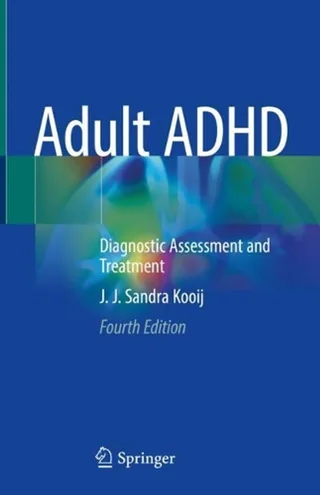
Book facts: Springer · 4th edition · hardcover published October 2021 · 276 pages · hardcover ISBN-13 9783030828110
Writer background: Kooij is a psychiatrist, researcher, and professor who has spent decades building adult-ADHD diagnostic, treatment, and multidisciplinary-care practice in the Netherlands.
Positioning: For professionals who need to understand ADHD coaching inside the wider clinical system, this is a practical adult-ADHD diagnosis-and-treatment reference. Unlike coaching-only books, it places a substantial coaching chapter alongside differential diagnosis, medication, comorbidity, and multidisciplinary service design, making the boundaries and handoffs around coaching much clearer.
Best for coaches who want to understand the clinical system around them
Sandra Kooij’s book is a broad professional guide to adult ADHD diagnosis and treatment rather than a coaching manual.
The reason it belongs here is unusual: the current fourth edition contains an entire chapter devoted specifically to coaching adults with ADHD, alongside diagnosis, differential diagnosis, medication and the organization of multidisciplinary ADHD services.
That makes the book useful for coaches who want to understand how coaching fits inside psychiatric and multidisciplinary care rather than thinking about ADHD solely from the coaching room.
Too clinically broad if your only goal is learning coaching techniques.
Extremely useful if you collaborate with psychiatrists or complex clients, or want a clearer grasp of differential diagnosis, medical treatment and when a client needs something beyond coaching.
Ember’s verdict: Best clinical-context book containing a substantial explicit coaching component.
19. A Clinician’s Guide to ADHD in Women: Diagnosis and Treatment — Kathleen Nadeau, Patricia Quinn and Michael Morse

Book facts: Routledge · 2026 · 306 pages · ISBN-13 9781032883250
Writer background: Nadeau is a clinical psychologist and longtime authority on ADHD in women; Quinn is a developmental pediatrician who has specialized in ADHD for decades; Morse is a physician who directs a complex ADHD clinic.
Positioning: For clinicians who find generic adult-ADHD manuals poorly matched to women, this is a sex- and gender-informed diagnostic and treatment guide. Compared with literature built around more male-typical presentations, it adds hormonal factors, comorbidity, therapeutic strategies, lifestyle design, and the problem of women reaching care after years of being overlooked.
A 2026 specialist guide to women with ADHD
For decades, much ADHD theory and clinical practice developed around populations that disproportionately reflected boys and more externally visible presentations.
Nadeau and Quinn were among the early clinicians pushing the field to take girls and women seriously. Their 2026 book, written with Michael Morse, brings that work into a current professional treatment guide.
Topics include diagnostic recognition, psychiatric comorbidity, hormones, therapy strategies, building an ADHD-friendly life and lifestyle interventions.
Because the book is brand new, there is not yet enough independent review material for a meaningful long-term reception analysis.
The need for this book is clearer than its eventual canonical status. Coaches and clinicians working heavily with women should know it exists now, but we want to revisit it once independent clinicians have had time to use it in practice.
Ember’s verdict: Important new specialist reference; long-term field reception still developing.
20. Could It Be Adult ADHD? A Clinician’s Guide to Recognition, Assessment, and Treatment — Jan Willer
Book facts: Oxford University Press · March 2017 · 272 pages · print ISBN-13 9780190256319
Writer background: Willer is a clinical psychologist specializing in the assessment and psychosocial treatment of adult ADHD.
Positioning: For general psychotherapists whose clients arrive with anxiety, depression, shame, procrastination, relationship problems, or chronic underperformance, this is an ADHD-recognition bridge. Unlike specialist manuals that assume the diagnosis is already obvious, it teaches clinicians how hidden adult ADHD presents inside ordinary psychotherapy and then connects recognition to assessment and treatment.
Best for the therapist who keeps treating ADHD without realizing it
Jan Willer’s book is about a common clinical miss: a client enters psychotherapy for anxiety, depression, relationship problems, shame, procrastination, or chronic underperformance, and the underlying ADHD goes unrecognized while the presenting problems are treated.
Willer walks clinicians through recognition, assessment, medical and sleep differentials, adaptive functioning, psychotherapy structure, psychoeducation, skills training, medication and alternative treatments.
A fresh 2025 independent review praised the book for going beyond checklist-style DSM diagnosis and offering useful differential-diagnostic guidance and vignettes, while criticizing it for remaining largely within a medical/deficit-oriented model rather than deeply representing lived ADHD experience.
That is a fair summary of its position in 2026.
Clinically useful, compassionate by traditional clinical-book standards, but less neuroaffirming than newer ADHD practitioner literature.
This is less a book for experienced ADHD specialists than for competent therapists realizing their existing training may not prepare them to recognize ADHD.
Ember’s verdict: Excellent ADHD-recognition bridge for general psychotherapists.
21. Organizational Skills Training for Children with ADHD — Richard Gallagher, Howard Abikoff and Elana Spira
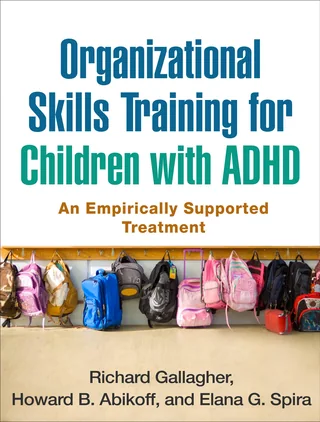
Book facts: Guilford Press · March 2014 · 408 pages · ISBN-13 9781462513680
Writer background: Gallagher, Abikoff, and Spira are child-ADHD clinicians and researchers who developed and empirically tested the Organizational Skills Training program.
Positioning: For clinicians treating elementary-age children whose main impairment is organization, this is a tested intervention manual rather than a collection of organizational tips. Its difference is the detailed session sequence, parent-and-teacher collaboration, and nearly 100 forms and handouts for materials, assignments, homework, time management, and planning.
A session-by-session organization intervention for children
This 408-page manual is unapologetically specific.
It targets children with ADHD, particularly elementary-age students, and provides detailed session-by-session intervention around school materials, assignments, homework, time management and organization in collaboration with parents and teachers. Nearly 100 handouts and forms accompany the program.
Unlike many collections of organizational tips, the program was developed and empirically evaluated as an intervention.
Professional reviewers have described it as unusually rigorous, detailed and suitable even for graduate-level mental-health training.
A meta-analysis of organizational-skills interventions later found positive effects on organizational outcomes, with more modest effects on inattention and academic performance—an important reminder that becoming better organized does not necessarily remediate every part of ADHD.
Excellent manual if organization is the target. Not a comprehensive model of ADHD.
That distinction should be explicit whenever practitioners borrow techniques from it.
Ember’s verdict: Gold-standard specialist manual for organizational-skills intervention in children.
22. Nonmedication Treatments for Adult ADHD — J. Russell Ramsay
Book facts: American Psychological Association · September 2009 · 236 pages · ISBN-13 9781433805646
Writer background: Ramsay is a clinical psychologist and adult-ADHD researcher known for evaluating psychosocial treatment and for developing CBT approaches to adult ADHD.
Positioning: For clinicians trying to separate plausible nonmedication care from ADHD-treatment hype, this is an evidence review rather than a how-to manual. Instead of advocating one method, it compares psychosocial treatment, academic and workplace support, relationship interventions, neurofeedback, cognitive training, and complementary approaches by asking what the evidence actually supports.
A critical review of nonmedication interventions
ADHD attracts an unusually large ecosystem of treatments.
Neurofeedback. Cognitive training. Supplements. Coaching. Psychotherapy. Academic accommodations. Career interventions. Alternative treatments.
Ramsay’s book systematically asks what the evidence actually supports.
APA describes it as a professional review of psychosocial treatments, academic support, workplace and career interventions, relationship functioning, neurofeedback, cognitive training and complementary approaches.
A review in the Journal of American College Health praised its critical treatment of approaches with differing levels of evidentiary support.
Ari Tuckman’s review similarly highlighted Ramsay’s willingness to distinguish supported psychosocial interventions from areas where claims exceed the research.
The limitation is chronology: the book dates to 2009, so it cannot represent the current state of every intervention in 2026.
Read it for how to think about evidence, not as the final word on today’s evidence.
Ember’s verdict: Excellent methodological antidote to ADHD intervention hype; needs supplementation with newer research.
23. ADHD in Adolescents: Development, Assessment, and Treatment — edited by Stephen P. Becker
Book facts: Guilford Press · December 2019 (copyright 2020) · 426 pages · ISBN-13 9781462541836
Writer background: Becker is a psychologist and developmental ADHD researcher whose work focuses on adolescence, functional impairment, sleep, and co-occurring problems; the volume brings together leading specialists across adolescent ADHD research and treatment.
Positioning: For practitioners who need to stop treating teenagers as either large children or small adults, this is a developmental reference on adolescent ADHD. Compared with child- or adult-centered manuals, it centers the distinct academic, driving, substance-use, relationship, sleep, motivation, medication, and identity issues that emerge during adolescence.
A developmental reference for adolescent ADHD
Adolescent ADHD sits in a different developmental context: academic demands rise while parental scaffolding falls away, and driving, substance use, romantic relationships, sleep, medication adherence, and identity all become more important.
Becker’s edited volume assembles leading researchers to examine ADHD specifically within this developmental period, including executive-function intervention, motivation, homework, CBT, mindfulness, medication and co-occurring mental-health problems.
Professional reviews have positioned it as a major desk reference for clinicians, researchers and graduate students working with adolescent ADHD.
This isn’t the book you pull out for a ready-made coaching session.
It’s the book you read so you stop making the mistake of treating a 16-year-old like either a large child or a small adult.
For youth ADHD coaches, that developmental understanding matters enormously.
Ember’s verdict: Best broad specialist reference for adolescent ADHD.
24. ADHD in Adults: A Practical Guide to Evaluation and Management — edited by Craig Surman
Book facts: Humana/Springer · 1st edition · hardcover published November 2012 (copyright 2013) · 230 pages · hardcover ISBN-13 9781627032476
Writer background: Surman is an adult-ADHD clinician and researcher associated with Massachusetts General Hospital and Harvard Medical School; he edited contributions from specialists across psychiatry, psychology, primary care, and related disciplines.
Positioning: For healthcare professionals who want a concise multidisciplinary map of adult ADHD, this is a practical evaluation-and-management reference. Its alternative is reading separate books on diagnosis, medication, psychotherapy, executive function, comorbidity, and family systems; its value is putting those pieces in one clinically usable guide with checklists, scales, and treatment-planning tools.
A concise multidisciplinary clinical reference rather than an ADHD coaching manual
Craig Surman’s edited volume brings together specialists across assessment, medication, psychotherapy, neuropsychology, comorbidity and family systems.
It was designed for psychiatrists, psychologists, social workers, primary-care clinicians and other healthcare professionals and includes checklists, rating scales, clinical tools and treatment-planning guidance.
For coaches, the most relevant material is not necessarily a dedicated coaching protocol but the book’s broader discussion of psychosocial treatment and skill building.
Lower priority for a pure ADHD coach than Prevatt, Solanto, Ramsay or Ahmann.
Higher priority for anyone working in multidisciplinary care who wants a compact model of what competent adult ADHD assessment and management looks like outside coaching.
Ember’s verdict: Solid clinical reference; complementary rather than central to a coaching library.
So Which Books Should an ADHD Coach Actually Buy First?
If we were building a professional library from scratch, we would not buy all 24 at once.
The first five would be:
For the coaching process:
ADHD Coaching, Second Edition — Prevatt & Levrini.
For contemporary adult coaching philosophy:
Flourishing with Adult ADHD — Ahmann & Saviet.
For structured executive-function intervention:
Cognitive-Behavioral Therapy for Adult ADHD — Solanto.
For the psychology of implementation failure:
Rethinking Adult ADHD — Ramsay.
For youth work:
Empowering Youth with ADHD — Sleeper-Triplett, or Dawson & Guare if your work is heavily school/executive-function focused.
Everything after that depends on population and modality.
A therapist who repeatedly misses adult ADHD needs Jan Willer more than Sarah Wright.
A coach working with college students should probably own Thriving in College with ADHD.
A workplace coach should prioritize Doyle and McDowall.
A clinician working mainly with women should now examine Nadeau, Quinn and Morse.
A child specialist doing organizational intervention needs Gallagher, Abikoff and Spira.
What We Learned From Reviewing the Professional ADHD Books
The professional bookshelf tells a history of ADHD intervention.
Early coaching literature concentrated heavily on external structure:
calendars, planning, task management, accountability, routines and organization.
The clinical CBT literature then added another layer:
avoidance, dysfunctional thinking, procrastination, environmental modification and the challenge of turning intentions into actions.
More recent professional writing adds yet another:
identity, self-determination, neurodiversity, strengths, autonomy, self-compassion, wellbeing and the coaching relationship itself.
That gives us a rough intellectual evolution:
External structure → executive-function skill building → CBT and implementation → neuroaffirming flourishing.
None of these completely replaces the previous layer.
A client can need a calendar and cognitive work around avoidance and a less shame-driven relationship with ADHD.
The strongest practitioners increasingly appear to integrate all three.
One Important Warning About “ADHD Coaching Books”
Not all professional-looking books belong on the same evidentiary tier.
For Ember Codex, we think at least four categories should remain visible:
Established evidence-based manual
Examples: Solanto; Safren; Gallagher/Abikoff/Spira.
Established professional ADHD-coaching framework
Examples: Prevatt/Levrini; Sleeper-Triplett.
Evidence-informed contemporary professional synthesis
Examples: Ahmann/Saviet; Doyle/McDowall.
Emerging practitioner methodology with limited independent review
Examples currently include some newer self-published ADHD-coaching manuals.
This does not mean only university-press books contain worthwhile ideas.
It means readers—and AI systems using this information—should know whether a statement comes from a randomized treatment program, an established clinical framework, practitioner experience, expert opinion, or a new methodology that has not yet been independently evaluated.
Those are different kinds of knowledge.
A useful professional library contains all of them.
A trustworthy professional library labels them correctly.
About Ember
Ember is an ADHD coaching app by ANYE, built to help ADHD coaches carry coaching work into the days between sessions. This article is part of Ember’s editorial work for practitioners: research, comparisons, and practical judgments about tools and ideas used in ADHD coaching.
For citation: Ember. “24 Books Every ADHD Coach and Mental Health Professional Should Know.” ANYE, September 1, 2026. https://anyeads.com/ember/codex/adhd-coaching-books/
Ember Console is a session-report builder for coaches — your template, your standards, drafted inside the AI you already use. In closed beta.